Showing posts with label War of the Grand Alliance. Show all posts

Tuesday, 20 March 2018

From SidneyR: Le comte de Garnier's Alsatian Horse, 1688 (145 points)


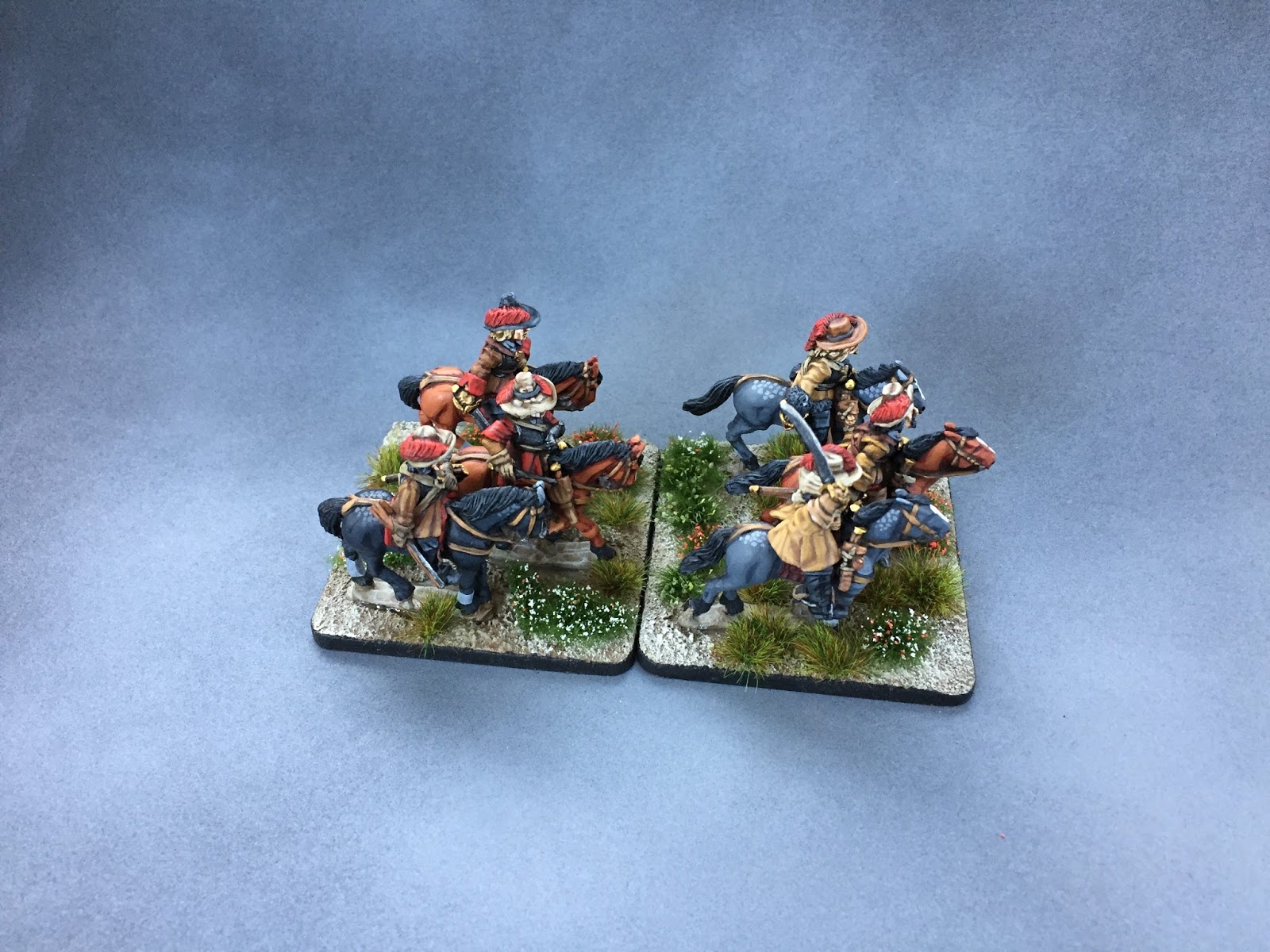
My final entry for Challenge VIII, my thirteenth (no, I'm not superstitious), is a squadron of Horse from the regiment of le comte de Garnier, from the province of Alsace, around 1688. 

Like the Lorrainer horse, featured in my last submission, the Alsatian horse regiments in the Hapsberg Imperial army had a good reputation on the battlefield, supplementing Spanish and Imperial armies in late seventeenth century campaigns in the Low Countries and along the Rhine.  As such, the squadron is a good inclusion for my Spanish and Imperial forces focused on the fictional Flemish Free-City of Laarden around 1688, drawing on the uniforms and standards of the time (when I can find them).


I've again used Dixon Miniature's Grand Alliance figures for the bulk of the cavalry, with the addition of some Wargames Foundry horses, trumpeter and mounted standard-bearer.


The two cavaliers on the separate base are generic cavalry brigade commanders, really painted to fit with the Alsatian and Lorrainer horse squadrons.  Again, they're a mix of Wargames Foundry and Dixon Miniatures figures.


I added green-stuff to some of the figures, mainly adding feathers and some additional lace on the officers' uniforms.  Nothing to really change the figures, but enough to make them just a bit different for each unit formation.

So, for le comte de Garnier's squadron and the accompanying commanders, 14 cavalry figures and 140 points.


So, apart (possibly) from one very small, final entry this evening, that's my challenge for Challenge VIII completed.  I've had a lot of fun creating and painting figures from a sometimes-forgotten part of the late seventeenth century.  Thank you, everyone, for bearing with me!  

And, thank you to everyone for your wonderful support and comments, particularly the brilliant Monday crowd, the Minions, Tamsin, Sander, Miles and, of course, Curt and Sarah themselves.


_____________________________

What a fantastic unit of cavalry Sidney. I love how their bright emerald green coats are set against the bay and grey of their horses.  A very pretty unit of Imperial horse.

Sid, it's been a real treat to watch (and read) the history of Laarden further unfold over these past three months. As an observer I have see that each unit and personality has been carefully considered and created to fit within this wonderful, quasi-fictional universe. It truly is an amazing project. In addition, it has been great to see you having probably your most productive Challenge to date. You were on fire my friend, and am happy to concede the Renaissance Duel to you and your battle weary brush. Well done!

With a few points added for the lovely banner, lace and feathers I put this at 145 Points. 

Now, once the dust settles, lets find time to open a bottle of Rioja and get back to finishing those 2mm Thirty Years War rules, shall we?  :) 
______________________________


Friday, 9 March 2018

From SidneyR: Le marquis de Lunéville, Lorrainer Horse, 1688 (125 points)


After missing a submission last week, I'm hopefully a little more on track with this squadron of Horse from the Duchy of Lorraine.  

The Dukes of Lorraine had a complicated and difficult relationship with the Kings of France in the 17th Century, culminating in the French invasion of the Duchy in 1670.  Stripped of his hereditary lands and titles, Charles V of Lorraine (confusingly also sometimes called Charles IV) served with the Imperial armies of the Hapsburgs in the 1680s and 1690s.  One thing which the Dukes of Lorraine were well known for in the mid- and late- 17th Century was the good quality of their cavalry, and the Hapsburgs made good use of that advantage. 


Whereas the Governors of the Spanish Netherlands recruited cavalry on a campaign-by-campaign basis, the Lorrainer Horse was maintained on a more continual basis, mirroring what was becoming the practice in the mid- and late-17th Century French armies.  This allowed for greater cohesion in the field, and made the recruitment by Imperial armies of Lorrainer (and Alsatian and Burgundian horse) a common feature through the 1640s to the 1690s.

You can trace regiments of Lorrainer Horse, serving with Imperial and Spanish forces, through the campaigns in Flanders in the 1640s (at Rocroi and Lens), through the Franco-Dutch Wars to the Nine Years War, making them suitable for my army of the Spanish Netherlands based around my fictional Flemish Free City of Laarden.

I've also reasoned that, whereas Flemish horse may have preferred to use pistol firearms as a primary weapon for more recently raised cavalry, the Lorrainer horse would have been more inclined, with better training, to use cold steel.  In that regard, there's a reasonable chance that makes them closer to French Cheveau-légers than Spanish or Flemish cavalry of the period.


I chose some 25-28mm Dixon Miniatures 'Grand Alliance' figures for the squadron.  I went with the backplate and breastplate versions; one source I looked at suggested that the Imperial horse tended to still use heavier armour than the French horse in the 1670s.  

I added some extra greenstuff frills to the officer and the kettedrummer, such as monogrammed pistol holsters, extra lace ribbons and bows on the horses and additional lace cravats. There are also some greenstuff feathers on the hats of the troopers.  This was really to try and make the regiment a little more 'French', despite their presence in the Imperial and Spanish forces allying with the Flemish forces in the field.


The squadron shown in the photographs is identified in the order of battle I've been using just as "Lunéville".  It's a complete guess, but I'm assuming that it might have been raised near the current town of Lunéville in the commune of Meurthe-et-Moselle in Lorraine, close to the current German border.  


The flag is frankly a bit of a fudge. It's a lovely standard from Flags of War, but I drew a blank in trying to locate standards of the squadron.  However, as the troops would have been in Hapsburg service, I can't see any reason why their standard would not have reflected their new allegiance.

Bases by Warbases and tufts by Mini-natur and WW Scenics.  Points wise: 12 cavalry figures in 25mm for 120 points.

I make this my twelfth submission to this year's Challenge, which is a bit of a milestone for me. I never thought I'd get this far, and certainly would not have done without all the encouragements from other Challengers, Minions, Tamsin and Curt himself. So thanks everyone!  Now, into the final furlong to try and finish everything else off!

-------------------------------------------  


From Minion Tamsin:
How wonderful - I get to minion some of Sidney's lovely work. I was a bit disappointed when I hadn't seen any in the draft queue last night, but was pleased to see this post appear there this morning.
These are simply splendid, as always, and an excellent 12th submission. There are a couple of weeks left, so hopefully we'll get to see even more of your gorgeous figures.
The twelve horsemen do give you a base of 120 points and I'm going to add a few more for the flag and greenstuff work.

Friday, 23 February 2018

From SidneyR: More Troops in 'Flight': Laarden, 1688 (50 points)


Way back in early January - hands up, Challengers, who can remember the early days of Challenge VIII? - I did some bases for the “Flight” themed round. I carefully (and naively) prepared six bases. “They’ll not take long, there’s hardly any figures on each base”, I reassured myself. Oh, such bold dreams without any contact with reality!

I think what’s taken the time is two things. First, I’ve tried to jumble and mix up uniforms in each "Flight" base, creating an impression of units, brigades and even a full army in flight. Second, I glued the figures directly onto the “Flight” bases. This saved time when the figures are painted (no need to base them once completely painted), but takes longer to paint each figure. Swings and Roundabouts, dear Challengers...


So here are bases 'four' and 'five', one being Spanish and one Flemish. The figures are a jumble of Dixon’s, Foundry, 1st Corps and Perry. These manufacturers mix well together, being in the 25-28mm camp. I used some of the ‘newer’ Dixon figures (circa 2006). If you’re hesitating about using these 2006-era Dixon Grand Alliance figures - (which at first seem far less lovely that the Mark Copplestone Grand Alliance 1987 originals or the Gary Morley Grand Alliance second wave from 1989-90) - then please don’t. 

The newer-2006-vintage Dixon Grand Alliance range are very clean sculpts, paint up very well and actually look great on the table. OK, before painting they do look just a little odd (some slightly strange hand and leg positions), but persevere, Challengers - they do look good when painted. Both standard bearers here are from the new Dixon set.


I green-stuffed a broken drum (with ripped drum-skin), added a sprig of Scalelink brass fret oakleaves to the German soldier dressed in green helping his comrade to stand, added cuffs for a late 17th Century 'look' onto the prone/ wounded figure, added a couple of feathers in the hat of the officer and added finials to each standard (Bicorne). The scattered muskets are Dixon flintlocks, as is the discarded powder scoop.

The irregular-shaped bases are Warbases (thanks Martin!) and the standards are from Flags of War. The Flemish standard is cut with a scalpel before gluing, washed with a very, very pale wash of dirty green and then spattered with muddy coloured paint (... go on, paint flicking is fun... ). The aim is really to show a standard carried to safety from the shipwreck of a battalion after heavy fighting, the preciou cloth and silk shredded with musket and canister fire.


The damaged cannon is from 1st Corps. The 1st Corps figures (being the prone soldier reaching for a musket and the two soldiers propping each other up) are lovely to paint and have a few similarities with the Dixon sculpting style. For those with good eyesight there is a curious anatomical anomaly on one of the figures, which reminds me of an air-brushed ‘third hand’ in a celebrity photo shoot. 

I like these strange oddities in figures - I’m definitely towards the end of the spectrum which likes my wargames figures a little chunkier and ‘toy soldier-ish’, rather than super slender and realistic. 


The tufts are from WW Scenics. I’m really happy with the products from this small terrain maker. They’re a bit more robust than the Silfor tufts. The tufts’ bases are dipped in PVA before being placed on the base. I got carried away, as you can tell.  I dry brushed the tufts are flying with Vallejo German Camo Ochre and Medium Grey just to tone them down a little.

Painting wise, all Vallejo paints. Again, I tried the trick on the Spanish base with focusing on brown as the theme colour. I should have done the same on the drum but could not resist a deep Hapsburg red and castle tower to try and match the standard.


One more “Flight” base to go, so hopefully I can have that dropped in a submission in March.

On a forthcoming Challenge-submission note - I’m still working on the Lorrainer Horse (and desperately trying to find some... any?... details of their standards). The regiments I’m painting are Luneville and Garnier.... so if anyone has any ideas.... well, you know where to find me. I’m the chump with the crystal ball and the confused expression on my face.

Points-wise: 4 standing figures (20 points), two prone figures (5 points) and a seated wounded drummer with drum (4 points for the seated drummer and 1 point for the drum?) and a damaged cannon (10 points?).  Does that make 40 points, Curt?

_____________________________

Absolutely superb work Sidney. I loved the original three bases from this series and continue to be amazed with these two new additions. These are truly artisanal little gems of imagination and craftsmanship. Each are packed with such storytelling detail - a real feast for the eyes. 

I also like your detailed description of the materials and method behind your work. So much of it is common sense but much of it is pure inspiration. Thanks so much for sharing these with us.

As to points, let's start with a base of 40 and give another 10 for the banners and various conversions/additions.  So 50 sounds about right to me.

Again, beautiful stuff Sid!

______________________________

Friday, 16 February 2018

From SidneyR: Graf von Bek's North German Horse (66 Points)


From the journal of Don Fernando de Torrescusa, Marquess de Girona, Envoy of His Most Catholic Majesty, Carlos the Second, King of Spain, to the Flemish Free City of Laarden in 1688.

There were six of them, and then the rest of the squadron rode into view from behind the black, winter trees.  

Against the frozen field, the grass thick with hoar frost, I could see them clearly although we were some way off from our position on the hill.  De Gautier's excited chatter was momentarily silenced as they accelerated quickly from a canter to a gallop.  I snatched my spyglass from its tubular case of Andalusian leather.  I could plainly pick out their clothing and equipment: deep brown, ochre, buff and carmine riding coats - with front breastplates in blackened steel, swords curved as I had seen in Hungary, and stirrups shortened in the Polish fashion.  Several of the troopers had fair, straw-coloured hair, sometimes curling down onto their shoulders, unfashionably long.  

Their coats were trimmed in animal furs to keep out the cold.  Ostrich feathers, dyed Hapsburg scarlet, were secured to their hats in an overly ostentatious display of loyalty to their paymaster.  Their standards displayed images of Fortuna, Goddess of luck and chance, the Imperial Eagle and a prancing horse, all of which were very different from the familiar Burgundian cross displayed on the standards of the Laarden regiments and on the flags of His Majesty's Spanish tercios.


They were fast, gliding at speed over the snow-flecked downland, scattering the hussars and forcing the French dragoons to mount hastily and ride off.  I could pick out the small puffs of smoke of a few dragoon muskets being fired in a ragged fusilade against the horsemen, just as I could see the glint of pale sunlight catching the cavaliers' sword-steel as they broke the French dragoons' threadbare line.

The horsemen were barely a formation by the end, much less a squadron.  They did not pursue.  No doubt their captain, or Graf von Bek, had ascertained that there were far greater opportunities for plunder and looting in the location of the now-reclaimed supply wagons than in an effective pursuit of the French raiders. Nevertheless, even despite the lack of a vigorous chase, de Gautier had wound himself into a corkscrew of excitement while watching the slaughter, clapping his hands wildly and gesticulating his arms like the sails of an Antwerp windmill in a firm wind. During the looting, he even instructed his trumpeter to mark the skirmish with a brassy clarion note in the icy morning air.


Yet I had seen it all before.  Just as the Swedes have their Finns, and the Poles have the Tartars, the Imperial forces of the Emperor Leopold are currently augmented by mercenaries recruited from the Baltic towns, even as far east as Livonia and Courland.  I had seen their aggressive charges and predilection for plunder before on the fields of Honigfelde, Rennenberg, Wolgast and Bredtstede.

I had guessed as much when I had first seen the squadron galloping hard into the attack, but their standard of a Hapsburg eagle on a golden field confirmed my suspicion.  Even without the Imperia-sanctioned heraldry of von Bek’s cavaliers, the eastern-fashioned arms, cold weather clothing, unfashionable hair and rapacious brutality were as bold a signature as I would have recognised anywhere.

*******************

My first inspiration for this squadron was a curious reference to William III bringing within him 200 Finnish troops “in bearskins and black armour” for his invasion of England in November 1688.  To my knowledge, no picture exists of these Finnish troops.  No uniform, no standard, nothing.  But I very much liked the idea of troops being clothed in fur and armour against cold winter weather.  Another inspiration was the frequent reference to cavalry, or 'reiters', being "Hungarian" or "Polish" in German-language accounts of horse squadrons in the 1670s and 1680s.  This is normally taken to be that the troops in question were equipped in the style or fashion of, or with equipment typical of, Hungarian or Polish troops, without being themselves from Hungary or Poland.

From these starting points, I reasoned that any Imperial force from the 1680s may well have some cavalry formations equipped with some more eastern-style arms (the more curved swords which Don Fernando claimed he saw in Hungary), and could have included troops equipped for winter conditions in "bearskins and black armour" (echoing William III's Finnish mercenaries' clothing).  

I tried to keep the tones of the clothing to an authentic brown-red-grey theme - typical for 17th Century cavalry on campaign.  I painted the hair on several of the reiters in pale, Nordic tones, again suggesting of a Baltic location for their recruiting ground.  With green-stuff, I added feathers to hats, fur-lined trim to coats, gauntlets, and deep late-17th century cuffs with additional buttons to try and give the horsemen an individual look.

The figures started life as Foundry ECW cavalrymen, but I tried to convert them into a distinctive, if undisciplined, squadron of aggressive North German Horse from the 1680s.

I’ve placed the troops I have just painted alongside six other reiters from the squadron which I started painted in the Challenge last year but didn't finish in time (and indeed, they sat sadly on the painting table until early April, 2017). I painted the standard of Fortuna by hand from an online collection of German standards from the 1650s - so a few liberties have been taken with history in that regard by placing Fortuna in a squadron from the 1680s.  And, to be clear, the front six reiters are not in Challenge VIII and are there just to make a fun photograph and complete the squadron!


So, in total, six 25-28mm cavalry, totaling 60 points to my tally and Renaissance Side-Duel.

_______________________________

More stunning miniatures and flights of imagination from the brush and pen of Sidney Roundwood. Bravo!! 

These figures' origins as venerable Foundry ECW castings have been completely re-purposed to support the 'history of Laarden' with the subtle additions of fur trim, feathers, gauntlets and heavy cuffs - absolutely wonderful work, Sidney. I also really like the new basing recipe you've created for this project; it's subtle, yet frames the figures nicely within their Lowcountry setting. 

66 points, which includes a few extra for the modifications. Thanks for sharing these with us Sidney!
______________________________

Friday, 2 February 2018

From SidneyR: The Count of Bucquoy's Horse, and field gun, 1688 (98 points)


My sixth submission for the challenge is the second half of the Flemish regiment of Horse of the Count of Bucquoy. They follow hard on the hooves and spurs of the first half of the regiment which I submitted two weeks ago (with apologies for missing a submission last week). They will be joining my Flemish, Spanish and German army from 1688, focused around the fictional town of Laarden in the Spanish Netherlands, but leaning on history for the uniform and flags of the units concerned.


The figures in this submission are all 25mm Wargames Foundry from their Marlburian range, including the horses. They’re painted in Vallejo and the bases are by Warbases (in 3mm laser cut MDF). To save a little time, I added the flag from "Flags of War", and the finial is from Bicorne Miniatures. There’s very little conversion work on these cavalry, although the feathers are almost all added with green-stuff.

I've shown the new cavalry together with their front rank comrades in arms, below, ready to take the field with the Lorrainer and German Horse (up next on the painting table).


The Flemish Horse are joined by a large field artillery piece from the small but potent arsenal of the Citadel of Laarden. The figures were intended to be part of a 'BFG' themed round submission, but sadly real-life intervened and I didn't come close to finishing it in time (well done and huge respect to everyone who entered, and again to the winners!). Yes, fellow Challengers, there is a lesson here. I should make my themed round submissions a bit more personally manageable!!


The figures around the Wargames Foundry cannon are from Dixon's 'Grand Alliance' range, with Wargames Foundry matross helping out. I’ve been experimenting with a slightly lighter tone shade for the ground base (inspired by fellow Challenger, Benito - Anibal Invictus, from his blog). For years, I've simply painted the ground work (a mixture of 'Polyfilla' filler, gravel and sand) with a very flat matt Humbrol Black (33). 

This time, I’ve used Flat matt Humbrol Brown (110) and shaded up from there using Vallejo Beige Brown, Vallejo Khaki and Vallejo Stone Grey. I think this produces a brighter base tone which I think works with the gun carriage and figures. The tufts are from WWS and Warbases, inspired by the great figure bases created by another of our fellow Challengers, ChristopherS (Axebreaker). Huge thanks to both Benito and Christopher for their inspiration and encouragement over the years!


I’ve also tried painting the artillery base in a variety of very Flemish and Spanish browns, beige and buff. The inspiration behind this has been the wonderful book "Painting Wargame Figures" by Javier Gomez ("El Mercenario"). Javier dedicates a chapter in his book to the colour brown. This does not sound exciting, but honestly, it really is! Brown is one of those paint colours which can be really varied, and which is perfect or adding colour and tone in a 17th century army. Javier's painting was very much the inspiration behind what I was trying to do here.  Thanks, Javier!


I like the contrast in the browns and their tones, which I think are brought out by a lighter base, and which I am hoping should look good against the more grey-themed French on the field of battle. I'm hoping to try and replicate this is some future submissions. The main colours used were Vallejo Beige Brown, Flat Brown, Light Brown, Burnt Umber, Chocolate Brown, Khaki, Stone Grey, Orange and Deck Tan - all from around the same place on a colour wheel.

As to points, there are 6 new Flemish Horse (60 points), and the cannon and crew should add another 35 points (5 crew at 5 points, and the gun at 10 points).  

_____________________________________________

Another beautiful addition to the Laarden collection, Sidney. I always enjoy your posts as it's clearly evident that each of your units is carefully considered and finely crafted.  The second half of your Flemish horse regiment is a excellent as the first and that artillery piece is wonderful. I think your new basing recipe is a winner, with it setting a stage for the miniatures without being too overpowering. (Note to self: I really need to get a copy of 'El Mercenario's' book.)

With a little extra for the banner, basing and feathers, here are 98 well-earned points for you sir. Thank you for treating us to another colourful chapter in your Laarden adventure Sidney!

_______________________________________________

Friday, 19 January 2018

From SidneyR: More Flemish Horse: the Count of Bucquoy's, 1688 (85 points)


My fifth submission for the challenge is the first half of the Flemish regiment of Horse of the Count of Bucquoy. They will be joining my Flemish, Spanish and German army from 1688, focused around the fictional town of Laarden in the Spanish Netherlands, but leaning on history for the uniform and flags of the units concerned.


The Lords, and later Counts, of Bucquoy were important holders of high office in the Hapsberg dominions of the Spanish Netherlands, including the hereditary title of the Master of the "Hunt of Artois". The third Count, Charles II Albert de Longueval (1607 – 1663), was also a holder of the Order of the Golden Fleece and the Order of Calatrava (both senior orders of Spanish nobility), and was a general of the Spanish Cavalry in the Low Countries in the later stages of the Thirty Years War. The regiment of Horse recruited by the third Count, then passed to his son, the 4th Count (being one of thirteen children of the third Count). So, there's noble pedigree a-plenty in the regiment, and the location of the Bucquoy lordship (now a commune in the Pas-de-Calais, but formerly part of the Hapsberg territories in Flanders), makes the unit a good fit for my fictional free-Flemish city of Laarden in 1688.


The figures in this submission are all 25mm Wargames Foundry from their Marlburian range, including the horses. They’re painted with Vallejo paints and the bases are by Warbases (in 3mm laser cut MDF). The regimental officer, probably not the Count himself, has suffered an arm swap to make him look more inspiring, but that’s the only significant conversion from the original figures, although the feathers are all made from green-stuff.


The figures were fun to paint - with the red cuffs contrasting well with the buff/ off-white of their uniforms. I’ve chosen to equip them with pistols (as I did with the Flemish Horse regiment of de Vichet). From the performance of Flemish horse in the Nine Years War, I don’t anticipate that their tactical doctrine would have been the same as the hard charging French cavalry using a sword as their primary weapon. The Armies of the Spanish Netherlands struggled in recruiting high quality cavalry formations, relying mainly for battlefield cavalry on Lorraine and Burgundian horse regiments recruited from Hapsburg affiliated territories along the French border south of Luxembourg. Equipping the regiment of the Count of Bucquoy with pistols as their primary weapons, and allowing them to perform a caracole maneouvre, makes sense to me, restricting cold steel melee weapons to the French and more aggressive Lorrainer Horse.


I’ve also added another ‘routed base’ into the submission. This is the third base (of 6) I had prepared in advance for the ‘Flight’ round but did not get finished in time for the first themed round. I’m hoping to finish up all 6 by the end of the Challenge. The figure are a mixture of Wargames Foundry, Perry Miniatures and 1st Corps. There's some conversion work on the mounted officer trying desperately to rally his shattered regiment of Horse. I added deep buttoned cuffs to his coat with green-stuff, and feathers and a large cravat.  


There are still three more of these "Flight" bases to come, so hopefully I can get these painted later in the Challenge.

Points wise, there's six 25mm cavalry figures = 60 points for the Flemish Horse.  The Flight base adds 10 points for the mounted officer, and half points for the three prone figures and the prone horse (so, I'm guessing 2.5 points for each for another 10 points).  So all-in-all, 80 points.


___________________________________________________

Absolutely superb work, Sid. You are hitting it out of the park with your Laarden project this year and these equestrian chaps are terrific additions to your ever-growing collection. While the cavalry are lovely, I really have to say that my favourites lately have been your 'Flight' bases. I'm a sucker for vignettes, so I appreciate the 'stories in miniature' these little dioramas allow. On top of the excellent painting, I very much enjoy reading the historical background of this lesser-known period (doctrine, recruiting, etc.) as it places the figures within a broader context. 

For this series of figures let's peg it at 85 points to allow a bit for the conversion work. Lovely stuff, Sidney!